
The Paradox of Hospitality Marketing: Where Does the Money Really Go?
Why the industry obsesses over creatives but spends 65% of its budget on distribution—and why that needs to change.
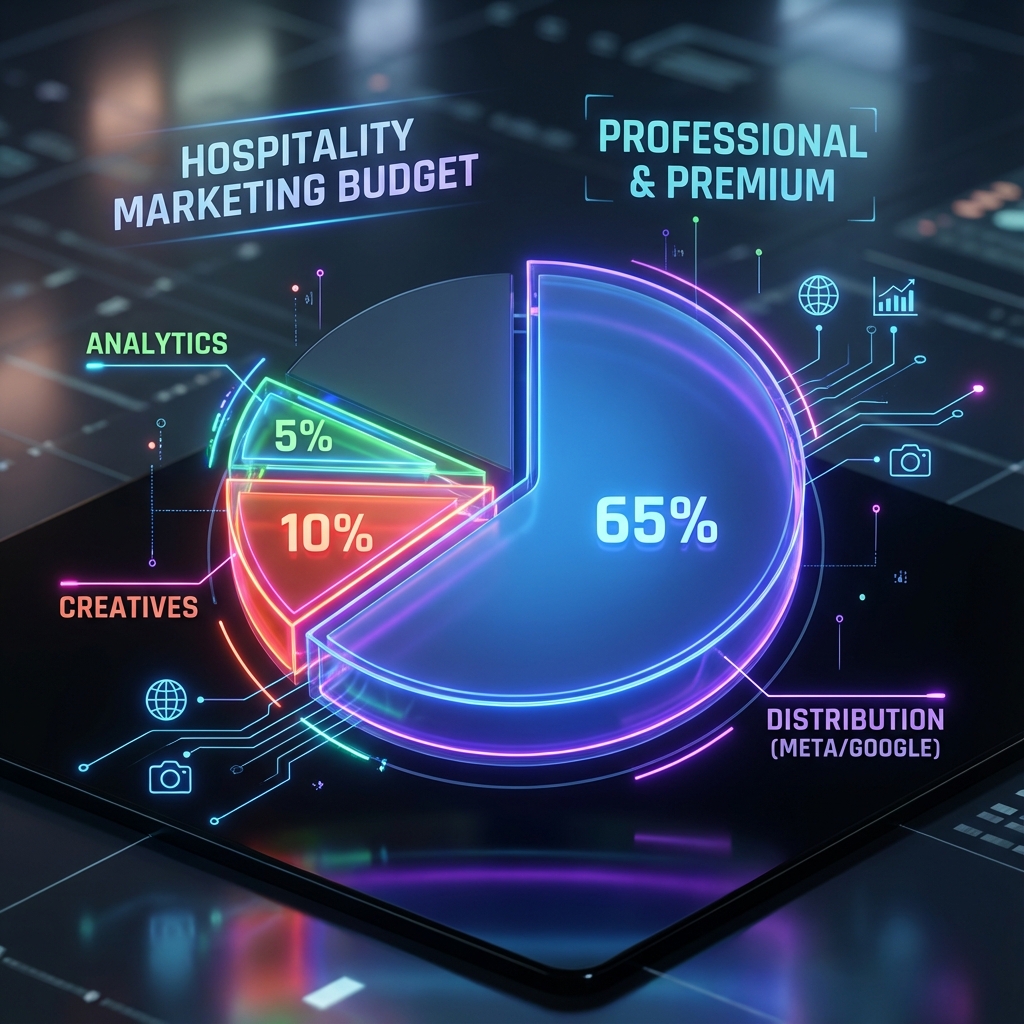
In the high-stakes world of hospitality marketing, perception rarely aligns with financial reality. We recently analyzed the marketing spend breakup for players across the US and India, and the results paint a startling picture of an industry obsessed with aesthetics but enslaved by distribution platforms.
The Reality of the Marketing Pie
When we peel back the layers of annual reports and budget sheets, the actual allocation of funds reveals a stark hierarchy. Here is how the marketing pie is actually sliced:
- Meta/Google/Affiliates (Distribution): 65%
- Non-Creative/Non-Technical Labor: 20%
- Creatives (Content & Design): 10%
- Martech & Analytics: 5%
The Creative Paradox
Walk into any hospitality marketing meeting, and 70% of the conversation will revolve around 'Creatives'. We obsess over the perfect Instagram shot, the color grading of a video, and the font on a banner. We debate the aesthetic appeal of a campaign for hours. Yet, when the invoice comes, these creatives account for only 10% of the budget. We talk about art, but we pay for distribution.
The Distribution Monopoly
A staggering 65% of the budget is swallowed by the distribution giants—Google, Meta, and affiliates. This is the 'rent' we pay to be seen. These platforms have total control over audience targeting, making it an expensive, everyday necessity. It’s a pay-to-play ecosystem where you’re bidding against your neighbors for the same set of eyes. While necessary, this massive outlay restricts the agility of brands to experiment elsewhere.
The Analytics Void: A 5% Disaster
Perhaps the most critical insight is the dismal 5% allocated to Martech & Analytics. This is the industry's collective blind spot. We pour money into the distribution funnel but invest pennies in understanding what happens once a user clicks. This lack of investment in quality analytics—specifically customer journey tracking and attribution—leads to a massive misallocation of that expensive distribution budget.
"We are running wrong campaigns on wrong channels because we simply don't have the data to tell us otherwise."
To fix this, the ratio needs to shift. We cannot continue to treat analytics as an afterthought. Understanding the 'click-to-conversion' journey is the only way to reclaim control from the distribution giants. It’s time to stop just paying for traffic and start investing in the intelligence to convert it.